6
Fixed-Point Analysis of a Two-Membered Hypercycle
HYC-1979 Lesson 8: Acid, Amino, Acids
00:00

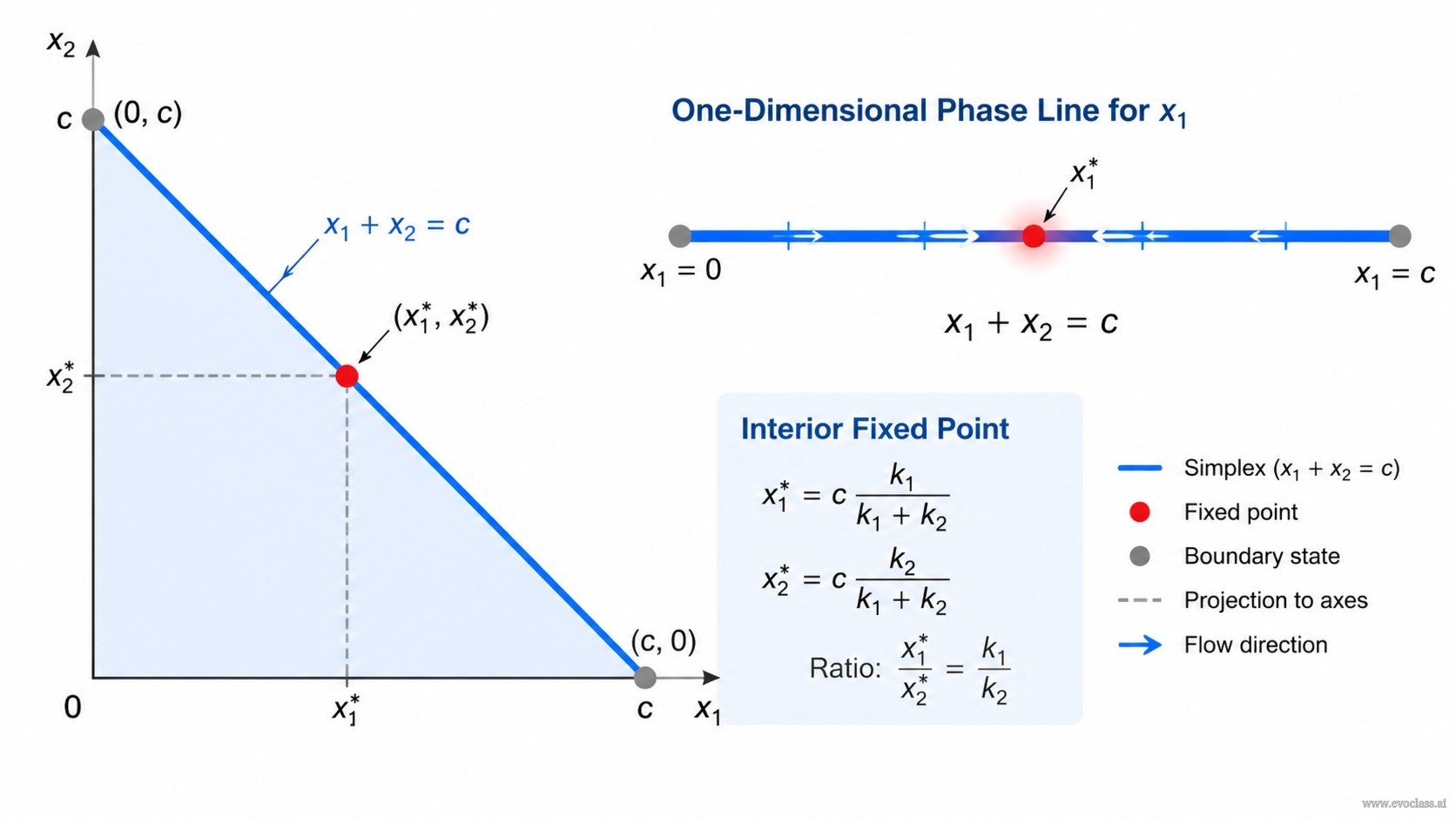
For a two-membered hypercycle under constant organization, the state space is the concentration simplex . The two variables and are the concentrations of the hypercycle members, and the total concentration c is held constant by a dilution flux Ξ¦.

Two-Membered Hypercycle: Fixed Point on the Concentration Simplex x₁ + xβ‚‚ = c concentration simplex x₁ xβ‚‚ (c, 0) (0, c) x* x₁* xβ‚‚* Phase line for x₁ 0 c x₁* flow toward the coexistence point Interior Fixed Point Balance condition k₁xβ‚‚* = kβ‚‚x₁* both brackets vanish; Ξ¦ cancels x₁* = c k₁/(k₁ + kβ‚‚) xβ‚‚* = c kβ‚‚/(k₁ + kβ‚‚) Equilibrium ratio x₁*/xβ‚‚* = k₁/kβ‚‚ larger kα΅’ β†’ larger equilibrium share Worked example: k₁ = 2kβ‚‚ x₁* = 2c/3, xβ‚‚* = c/3

Rate Equations and Interior Fixed Point

Under the standard rate convention, the dynamics are written as and . Here Ξ¦ is the dilution or flux term that maintains the constant total concentration c. An interior fixed point requires with , . This gives , hence .

Combining this balance with the constraint yields the unique coexistence equilibrium:

   and    .

The equilibrium ratio is . Under this rate convention, the larger effective catalytic constant receives the larger equilibrium share.

Boundary Fixed Points and Assumptions

The boundary fixed points are , and , . These are not coexistence states. The interior fixed point is the coexistence fixed point relevant to the two-membered hypercycle. The calculation assumes positive rate constants, mass-action kinetics, a well-mixed system, and no mutation, parasites, or time-dependent forcing.

Algebraic Reduction and Source Insight

The structure of the differential equations suggests an affine transformation of the x-coordinate system, familiar from the theory of linear differential equations. One obtains a new set of equations for transformed population variables that separates the constant-total constraint from the relative-abundance dynamics. This reduction makes the balance and the partition , transparent.

Worked Example

Normalize . Then and . If , then and . Equivalently, set and solve for its nonzero root.

Key takeaway
At the interior fixed point the two catalytic production terms balance the common dilution flux, so ; together with this gives and , with ratio .