Under constant organization the two-membered hypercycle holds the total concentration fixed, so the entire state is described by one number, the fraction , with . The growth equations for the two members are
where is the mean excess productivity that is subtracted from both equations. The diagonal constants and measure self-enhancement, while the off-diagonal constants and measure mutual, cross-catalytic enhancement. Because the same term Φ is removed from both members, the outcome depends on differences between rate constants rather than on their absolute magnitudes — and the same invasion analysis that locates the fixed points also sorts every parameter set into one of four coupling regimes.
Two invasion questions decide everything
Stability of a pure state is settled by asking whether the absent member can grow when it is rare in a population made up entirely of the resident member:
Can member 2 invade the pure state of member 1? Yes exactly when .
Can member 1 invade the pure state of member 2? Yes exactly when .
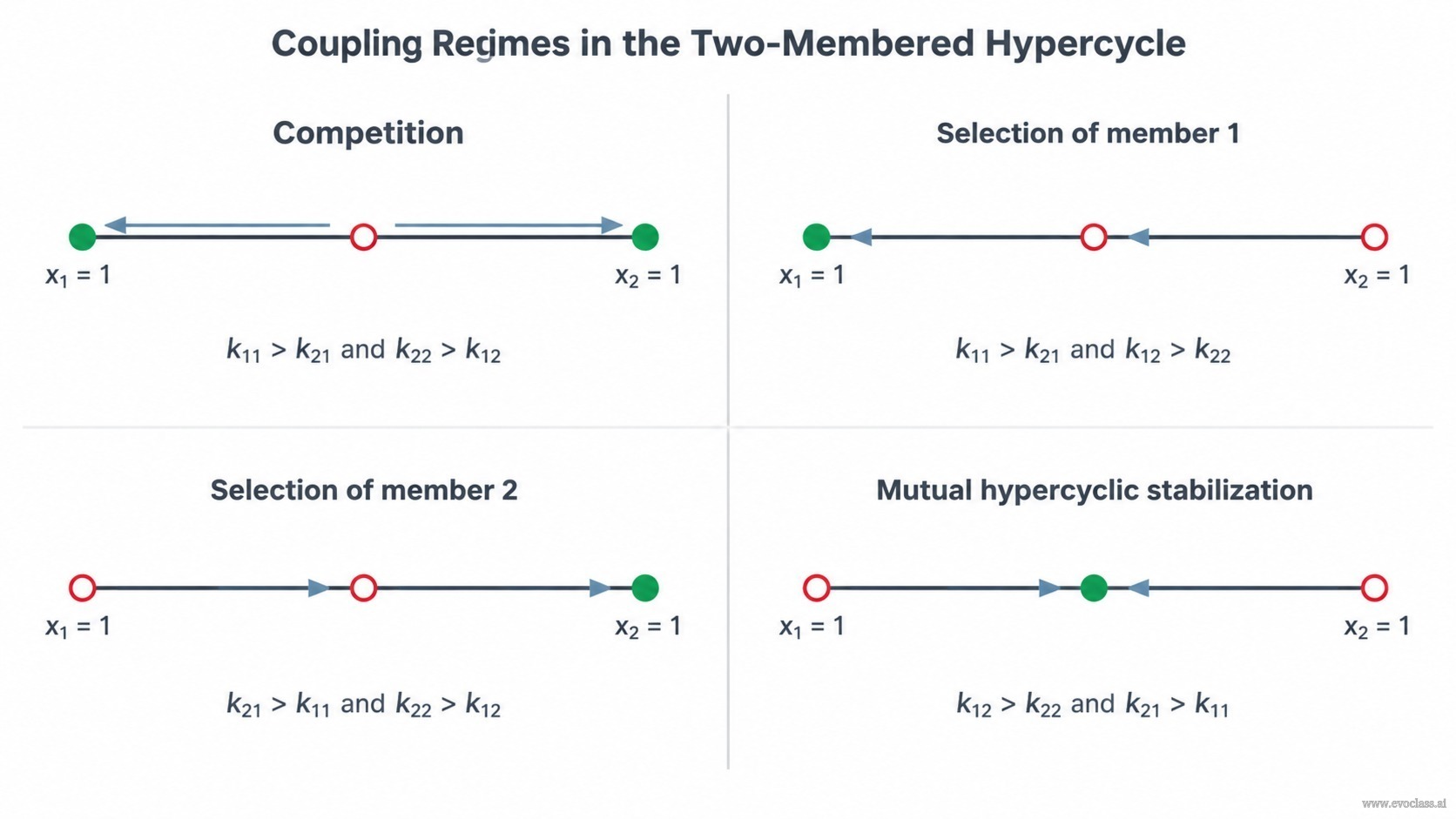
Each question has a yes/no answer, so the pair of questions generates exactly four cases — the four coupling regimes of Table 17.
Table 17: the four coupling regimes
Regime
Invasion inequalities
Stable fixed points
Interior fixed point
Competition
and
both corners, and
unstable separatrix
Selection of member 1
and
the corner
unstable
Selection of member 2
and
the corner
unstable
Mutual hypercyclic stabilization
and
the interior coexistence point
stable
Worked example
Take with . Then and , so the regime is mutual hypercyclic stabilization: each member can invade the pure state of the other, both corners are unstable, and the interior fixed point is attracting. Its position follows from the balance condition, , which gives . Start the culture at or at and it still relaxes to one half. Now reverse the numbers to and . The inequalities flip: neither member can invade the other, the two pure states are stable, the regime is competition, and the very same interior point becomes an unstable separatrix that merely divides which corner is reached.
Reading the regime without integrating
Because , the two-dimensional system collapses onto a single dimension, and the two corner eigenvalues reduce exactly to the two invasion inequalities above. Classifying a parameter set therefore costs two comparisons and requires no numerical integration and no simulation: the interior point is stable precisely in the mutual-stabilization regime and unstable in the other three. The same bookkeeping extends to three- and n-membered cycles (Table 18), where each member is tested by whether it can invade the community formed by the others, and cyclic symmetry makes the outcome a property of the rate-coefficient matrix as a whole rather than of any single pair.
Fast route to the answer
Test against , then against . Competition: no to both. Selection of member 1: no to the first, yes to the second. Selection of member 2: yes to the first, no to the second. Mutual hypercyclic stabilization: yes to both. Two comparisons replace the whole phase-plane calculation.
Coupling Regimes in the Two-Membered Hypercycle
Four phase portraits, one for each coupling regime of the two-membered hypercycle, summarised on the one-dimensional simplex with x at one end and x at the other. In competition the arrows run to both ends and the interior point is an unstable separatrix, so the starting mix decides the winner; selection of member 1 sends every trajectory to x and selection of member 2 to x ; mutual hypercyclic stabilization reverses both corner flows and funnels the system to the stable coexistence point in the interior.
QUESTION 1
A two-membered hypercycle under constant organization is measured with , , and . Which coupling regime does this rate matrix describe?
Mutual hypercyclic stabilization: each member can invade the pure state of the other
Selection of member 2: member 1 cannot invade, yet member 2 can invade member 1
Selection of member 1: member 2 cannot invade, yet member 1 can invade member 2
Competition: and , so neither member can invade and both pure states are stable
✅ Correct!
Correct. Here is not greater than , so member 2 cannot invade the pure state of member 1; and is not greater than , so member 1 cannot invade member 2. Neither invasion succeeds, which is precisely the competition case: both pure states are stable and the interior point is an unstable separatrix.
❌ Incorrect
Evaluate the two invasion inequalities separately. Is ? ( is false.) Is ? ( is false.) Two false answers mean competition, not selection or mutual stabilization.
QUESTION 2
Which pair of inequalities is the defining signature of mutual hypercyclic stabilization in the two-membered hypercycle?
and
and
and
and
✅ Correct!
Correct. Mutual enhancement prevails on both sides: member 1 can invade member and member 2 can invade member . Both pure states are unstable and the interior coexistence point is stable.
❌ Incorrect
Mutual stabilization needs both invasions to succeed, and each invasion matches a cross-catalytic term against the self-enhancement term of the resident it attacks: for member 1 invading member 2, together with for member 2 invading member 1. Pairs that set a cross term against the wrong self term, or that reverse one of the comparisons, do not describe this regime.
QUESTION 3
In the competition regime, and , what actually decides which member eventually dominates the culture?
The initial composition relative to the unstable interior fixed point
The value of Φ, which selects the surviving member
The member with the larger self-enhancement constant always wins
The balance point of the two invasion terms, which attracts the culture to a fixed mixture
✅ Correct!
Correct. Both corners are stable in this regime, so the interior point is not an attractor but a separator: cultures started on one side of it end at , cultures started on the other side end at .
❌ Incorrect
Two stable pure states cannot both be reached from the same initial condition. The interior fixed point is unstable here and acts as a separatrix, so the starting fraction determines which of the two attracting corners the trajectory reaches — size of the constants alone does not settle it.
QUESTION 4
Why can the coupling regime of a two-membered hypercycle be classified without numerically integrating the growth equations?
Because reduces the system to one dimension, and two corner invasion inequalities fix the stability of every fixed point
Because cyclic symmetry forces all four rate constants to be equal
Because the interior separatrix exists only when all four rate constants are equal
Because the mean excess productivity Φ is identically zero in every regime
✅ Correct!
Correct. Constancy of total concentration removes one degree of freedom, and the eigenvalues at the two corners are exactly the invasion inequalities, so two comparisons classify the whole parameter set.
❌ Incorrect
Φ is not zero — it is the mean excess productivity that enforces constant total concentration and cancels from the differences that matter. The shortcut comes from the box constraint , which leaves a one-dimensional flow whose fixed-point stability is decided by the two corner invasion tests; the interior point exists whenever both invasion conditions hold but its stability still follows from the same two inequalities.
QUESTION 5
A two-membered hypercycle has , , and . At the stable interior fixed point, what is the equilibrium fraction ?
, hence : the ratio : of the self-enhancement constants fixes the equilibrium fraction
, hence : the larger margin belongs to member 1, which therefore takes the majority share
, hence : member 1's invasion margin is two fifths of the total margin
, hence : a stable interior point always splits the two members equally
✅ Correct!
Correct. Both invasion tests pass ( and ), so the interior point is stable; , hence .
❌ Incorrect
First confirm the regime: and , so both invasions succeed and the interior point is stable. Then use , not 0.5, 0.6 or 0.25.
Case Study: A Two-Membered Replicator System on the Bench
Read the scenario and answer both questions.
A serial-transfer experiment maintains two self-replicating RNA species, and , at constant total concentration. Growth is proportional to fitness, , with . From dilution-series measurements the experimenter reports ⁻¹, ⁻¹, ⁻¹ and ⁻¹.
Q
1. Classify the coupling regime of this rate matrix using the two invasion inequalities, and state which fixed points are stable and which are unstable.
Answer: Test each invasion separately. Member 2 invades the pure state of member 1 because ; member 1 invades the pure state of member 2 because . Both invasions succeed, so the regime is mutual hypercyclic stabilization. Consequently the two pure states and are unstable, and the interior coexistence fixed point is the only stable state of the system.
Q
2. Compute the equilibrium composition (and hence ) and explain what happens to two cultures started at and at .
Answer: For the interior fixed point, . Substituting the measured rates gives , so . Because both corners are unstable in this regime, neither culture loses a species: the culture started near pure drifts down and the culture started with very little drifts up, and both converge on the same stable coexistence mixture .