Generalizing the Evolution Criterion to N-Membered Cycles
HYC-1979Lesson 8: Acid, Amino, Acids
00:00
Learning objective: Explain how the evolution criterion generalizes to three-membered and n-membered hypercycles using cyclic symmetry and the rate-coefficient matrix.
For a two-membered hypercycle, the fixed-point analysis reduces to comparing coupling constants. For three or more members, the same logic generalizes through the structure of the rate-coefficient matrix. The key is cyclic symmetry: every member is enhanced by the previous member in the cycle, so the matrix becomes circulant.
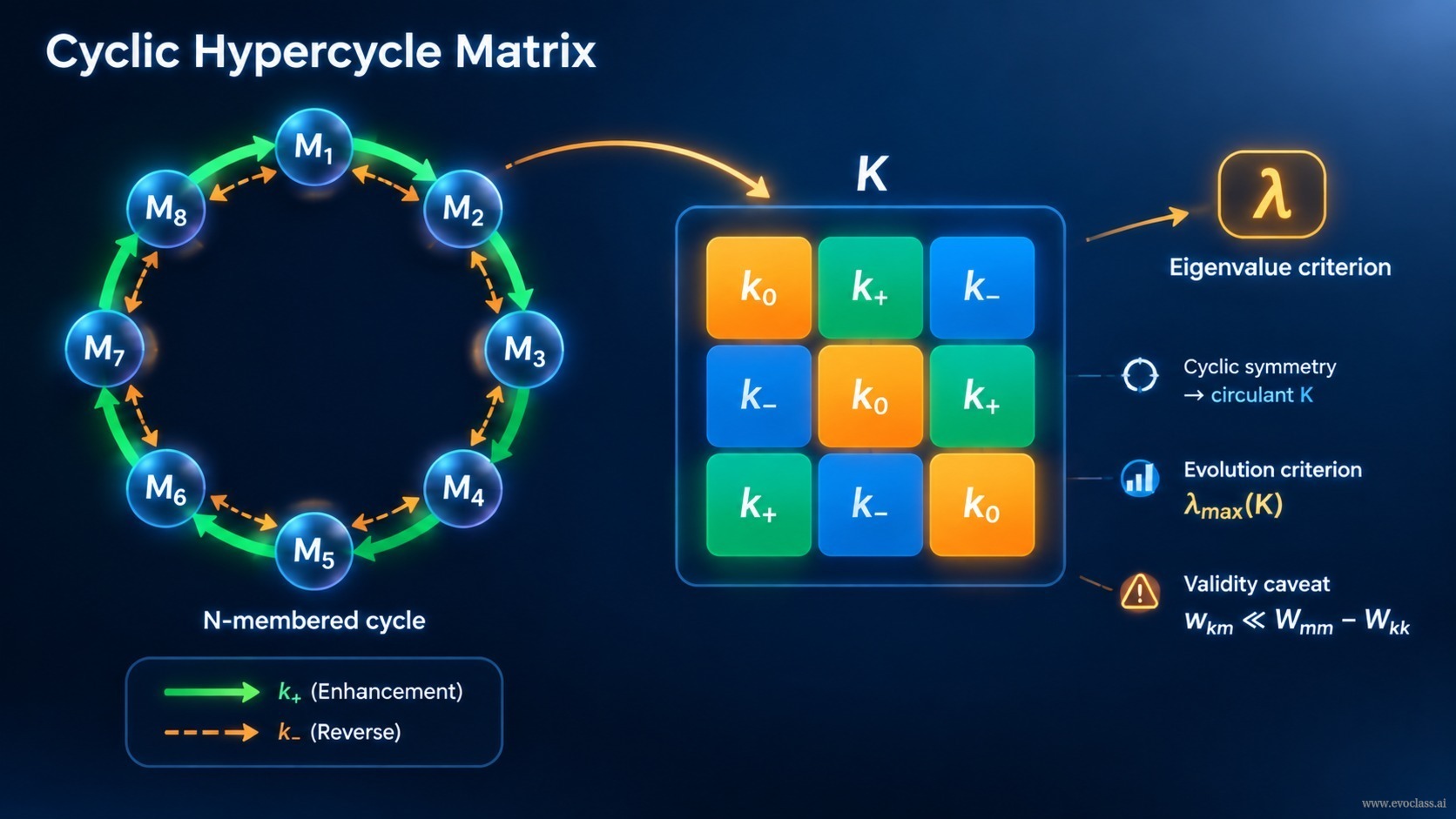
For three members, the rate-coefficient matrix is . Each row is a cyclic shift of the first row. This means no member is structurally privileged. The diagonal is the self/base term; and are the forward and reverse cyclic couplings. For N members, the same pattern shifts around an circulant matrix.
Generalized evolution criterion
The evolution criterion generalizes through , the maximum eigenvalue of K. Rather than isolated pairwise effects, encodes the integrated effect of the whole cyclic coupling pattern. A hypercycle configuration is favored when its exceeds that of competing alternatives under the same constraints.
The eigenvalue approximation is valid as long as (cf. Table 2). Higher approximations could be obtained using in whichever form it is expressed; Eqs. (16)-(18) would change accordingly.
More general nonlinear/saturating kinetics can be represented by rates or , so the criterion is the linear/weak-coupling limit.
Key takeaway
Cyclic symmetry turns the rate matrix into a circulant matrix, so the whole hypercycle’s selective advantage is captured by its maximum eigenvalue.
Cyclic Hypercycle Matrix
A ring of N members with forward and reverse enhancement arrows, beside the 3×3 circulant matrix K. The cyclic shifts of k 0, , and show that no member is privileged, and the evolution criterion is captured by (K).
QUESTION 1
What structural property of K for a three-membered hypercycle follows from cyclic symmetry?
K is circulant: each row is a cyclic shift of the first row.
K is always symmetric, so that equals in every row.
K is diagonal and contains only the self-terms on its diagonal.
K has rank one regardless of how many members the cycle has.
✅ Correct!
Cyclic symmetry makes each row a cyclic shift, so K is circulant.
❌ Incorrect
K is not diagonal, and it need not be symmetric; the circulant structure preserves the , , pattern.
QUESTION 2
Which statement best describes the role of (K) in the generalized evolution criterion?
It measures only the strongest single pairwise coupling constant.
It always equals the self/base term for every member count N.
It becomes irrelevant once the cycle has more than two members.
It captures the integrated effect of the whole coupling pattern.
✅ Correct!
(K) captures how the entire cyclic coupling pattern integrates, not just one pair.
❌ Incorrect
(K) is the maximum eigenvalue of the full rate-coefficient matrix and varies with N; it is not a single-pair term or a constant.
QUESTION 3
What does cyclic symmetry mean for an N-membered hypercycle?
Only one designated member receives any enhancement at all.
Each member is enhanced by the previous member in the cycle.
Couplings between members are random and unstructured.
Every member replicates independently of the other members.
✅ Correct!
Cyclic symmetry means the same enhancement pattern repeats around the ring.
❌ Incorrect
Cyclic symmetry imposes a repeating, structured enhancement pattern, not independent, single-member, or random coupling.
QUESTION 4
Under what condition is the eigenvalue approximation for the evolution criterion valid?
when (weak coupling vs. the diagonal gap)
only when the maximum eigenvalue is zero
only when every off-diagonal coupling is exactly zero
when (coupling exceeds the diagonal gap)
✅ Correct!
The approximation requires weak coupling relative to the diagonal gap, as stated in Table 2.
❌ Incorrect
The validity condition is , not the reverse or a zero-value condition.
QUESTION 5
How do nonlinear saturating kinetics relate to the criterion?
They apply only to hypercycles that contain exactly two members.
They replace the maximum eigenvalue with a fixed constant.
They reduce to the criterion in the weak-coupling limit.
They make the cyclic symmetry of the hypercycle impossible.
✅ Correct!
Saturating rates such as reduce to the linear criterion in the weak-coupling limit.
❌ Incorrect
The criterion is the linear/weak-coupling limit of more general nonlinear or saturating kinetics.
Case Study: Four-Membered Hypercycle
Read the scenario below and answer the questions.
You are modeling a four-membered hypercycle with a circulant rate-coefficient matrix K. Each member is enhanced by its two cyclic neighbors through the forward coupling and the reverse coupling , while is the self/base term.
Q
1. Write the general form of K for and explain why no member is structurally privileged.
Answer: K is a 4×4 circulant matrix. Its first row can be written [, , 0, ] (or equivalently [, , 0, ] depending on orientation), and each subsequent row is a cyclic shift of the previous row. The three coupling classes—self , forward (), and reverse ()—are distributed symmetrically around the ring, so every member experiences the same structural role. No member is privileged because the matrix is invariant under cyclic permutation.
Q
2. Explain how (K) generalizes the evolution criterion and state the validity condition.
Answer: The evolution criterion uses (K), the maximum eigenvalue of the circulant matrix, to encode the integrated effect of the whole cyclic coupling pattern rather than isolated pairwise interactions. A hypercycle configuration is favored when its exceeds that of competing alternatives. The eigenvalue approximation is valid as long as (cf. Table 2). Higher approximations can use in whichever form it is expressed; nonlinear saturating kinetics such as correspond to the linear/weak-coupling limit.
which is valid, as long as w_km ≪ W_mm - W_kk (cf. Table 2). Higher approximations could be obtained using in which-ever form it is expressed. Eqs. (16)-(18) would change accordingly. III. 6. Generalizations rate ~ / () or / ()