Slide 69 assembles indirect but convergent evidence that a single RNA strand could act at once as an adapter — a tRNA-like carrier that hands an amino acid to a growing chain — and as a messenger — an mRNA-like sequence that can be read. If both roles can live in one molecule, the barrier between hypercyclic RNA replication and primitive translation drops sharply: neither a separate class of adapters nor, at the very start, a synthetase had to appear before a message could be decoded.
Four Convergent Lines of Evidence
- tRNA sequence and structural alignments: adapter and messenger functions can reside in the same RNA family — one molecule carries both an amino-acid-accepting/transfer role and readable sequence information.
- Qβ midivariant de-novo synthesis: RNA can reproduce without a pre-existing translation apparatus, so large, reproducible, tRNA-sized RNA molecules are plausible before sophisticated translation exists.
- Simple β-sheet enzyme precursors: early functional proteins did not require complex folds; minimal peptides could provide primitive function without a fully folded enzyme.
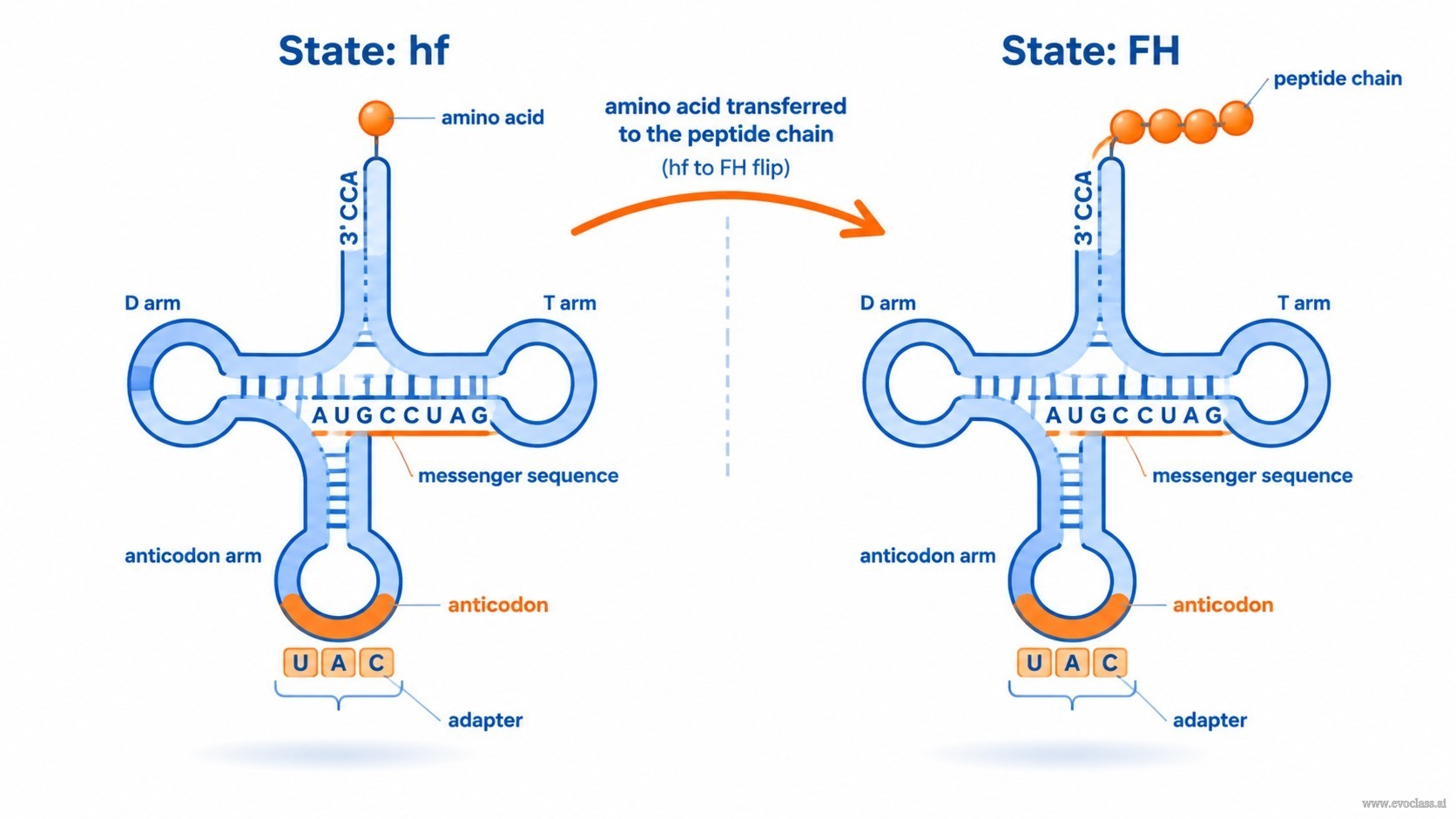
- tRNA conformational flexibility (hf ↔ FH): the adapter and the template roles are not fully separated into distinct RNA classes.
The hf ↔ FH Switch
Which of the two configurations is actually present depends on whether the tRNA is attached to an amino acid or to a peptide chain. By transferring an amino acid to the peptide chain, the tRNA flips from the hf to the FH configuration (cf. Fig. 49). The model explains well how, in the absence of a sophisticated translation apparatus, a message can be read off: the same strand that delivers an amino acid also exposes a readable sequence.
The Counterquestion to Take Seriously
How could an origin of translation be envisaged, given reproducible RNA molecules as large as tRNA and the prerequisites for synthesizing proteins in a primitive form from a limited number of sufficiently common amino acids? The question can be sharpened into an objection: "This question may be alternatively posed as: Why not small oligonucleotide adapters?" The dual-purpose model answers that the molecule must be long and structured enough to support both adapter recognition and messenger readability, so a tiny oligonucleotide would not suffice.
tRNA hf to FH Switch
A single tRNA strand shown in two states: hf, when it carries an amino acid, and FH, after that amino acid is transferred to a peptide chain. Because the same strand also exposes a readable sequence, the adapter role (anticodon recognition) and the messenger role (readable template) are not split into separate RNA classes — which is exactly why a message can be read off without a sophisticated translation apparatus.