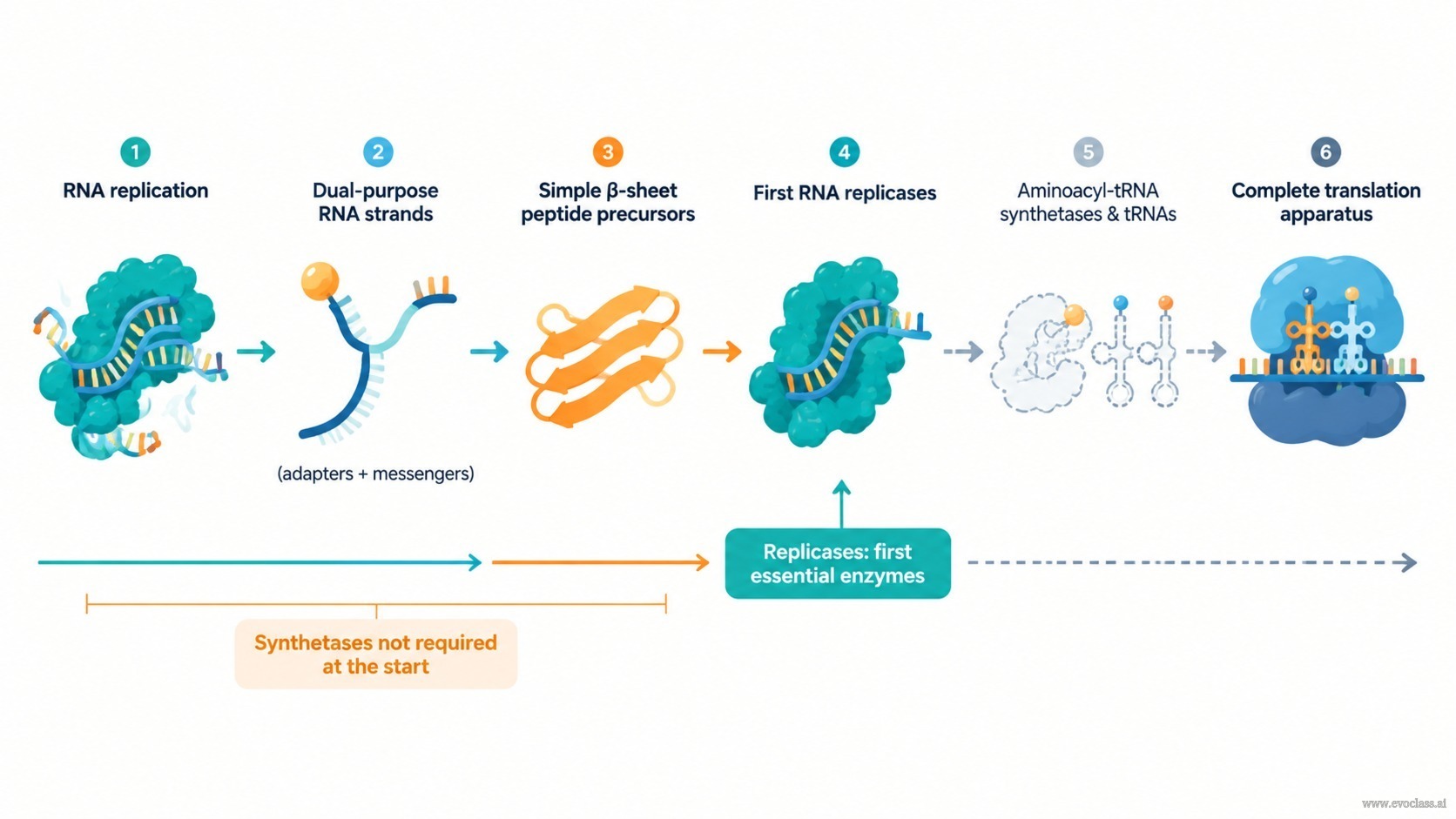
The closing step of this lesson asks a deliberately sharp question: what must already exist for peptide synthesis and information storage to be coupled at all? Read closely, the source material does not answer with "a simplified translation apparatus". The answer is rather that the earliest system was a minimal heritable catalytic system, in which RNA strands served simultaneously as messengers and as adapters, and in which the first genuinely indispensable catalysts were replicases — not aminoacyl-tRNA synthetases.
Functional coupling before a complete apparatus
Functional coupling means that an adapter carrying an amino acid and a messenger carrying the template are recognised by the same primitive machinery. If one and the same RNA strand can fold into an adapter-like conformation and also act as a template, the number of independent components required for translation-like peptide synthesis drops sharply. In such a scheme, peptide bond formation becomes possible before a ribosome, before a full set of tRNAs, and before any synthetase exists.
- Dual-purpose strands. A single RNA can combine the messenger (template) role and the adapter role, which is exactly what a minimal early translation system needs.
- Direct charging. RNA–amino-acid affinity and ribosome-free peptide transfer can supply the initial activation step that synthetases perform in modern cells.
- Conformational flexibility. The flexibility revealed by tRNA sequence alignments is precisely what allows one strand to occupy two functional roles at once.
- Simple catalysts. The first functionally active peptides were most plausibly short β-sheet or small catalytic peptides, not modern folded globular enzymes with deep active-site pockets.
Synthetases and separate tRNAs as later refinements
If start-up charging and adapter function can both be met without dedicated enzymes, then aminoacyl-tRNA synthetases and free-standing tRNA molecules become quality-control components rather than prerequisites. They tighten the match between codon and amino acid and raise translational fidelity. They are therefore best understood as refinements that appear once a coupled system is already replicating and already under selection — not as the conditions that make coupling possible in the first place.
Replicases: the first essential enzymes
Coupling alone is not sufficient. However elegant a translation-like cycle may be, it vanishes with the death of its molecules unless the information encoding it can be copied. This is the decisive argument of the slide: replication is what converts a one-off chemical coupling into a heritable, selectable function. RNA replicases — with the Qβ midivariant de-novo synthesis as the experimental analogue of such a replicase-centred minimal RNA system — supply exactly this capability. Once replication and peptide catalysis are functionally linked, the first genuinely enzymatic proteins can emerge and be retained.
Fidelity limits reinforce the same conclusion. A complete translation apparatus demands many accurately interacting components; at the error rates expected of an early replicase, such a large apparatus could not be maintained against the error threshold, whereas a short RNA quasi-species copied by a replicase can. The minimal replicase-first scheme is therefore not a simplification of convenience but a direct consequence of the fidelity limits of the era. Synthetases, separate tRNAs and full translation appear later as fidelity-enhancing refinements layered onto an already heritable core.
Minimal-Cell Timeline
A left-to-right pathway showing RNA replication, dual-purpose RNA strands that act as both adapters and messengers, simple β-sheet peptide precursors, and the first replicases highlighted as essential, followed by later synthetases and separate tRNAs and finally the complete translation apparatus. The causal takeaway is one of ordering: functional coupling can precede a full apparatus, but nothing in the system is inherited without a replicase.