The early hypercycle gains its advantage through functional coupling: each replicator catalyses the replication of a partner, and the partner returns the favour, so the members support one another without being physically joined. Translation itself is difficult to imagine starting any other way — a set of molecules cooperating through diffusible products rather than through one shared genome.
Cooperation Is Not Integration
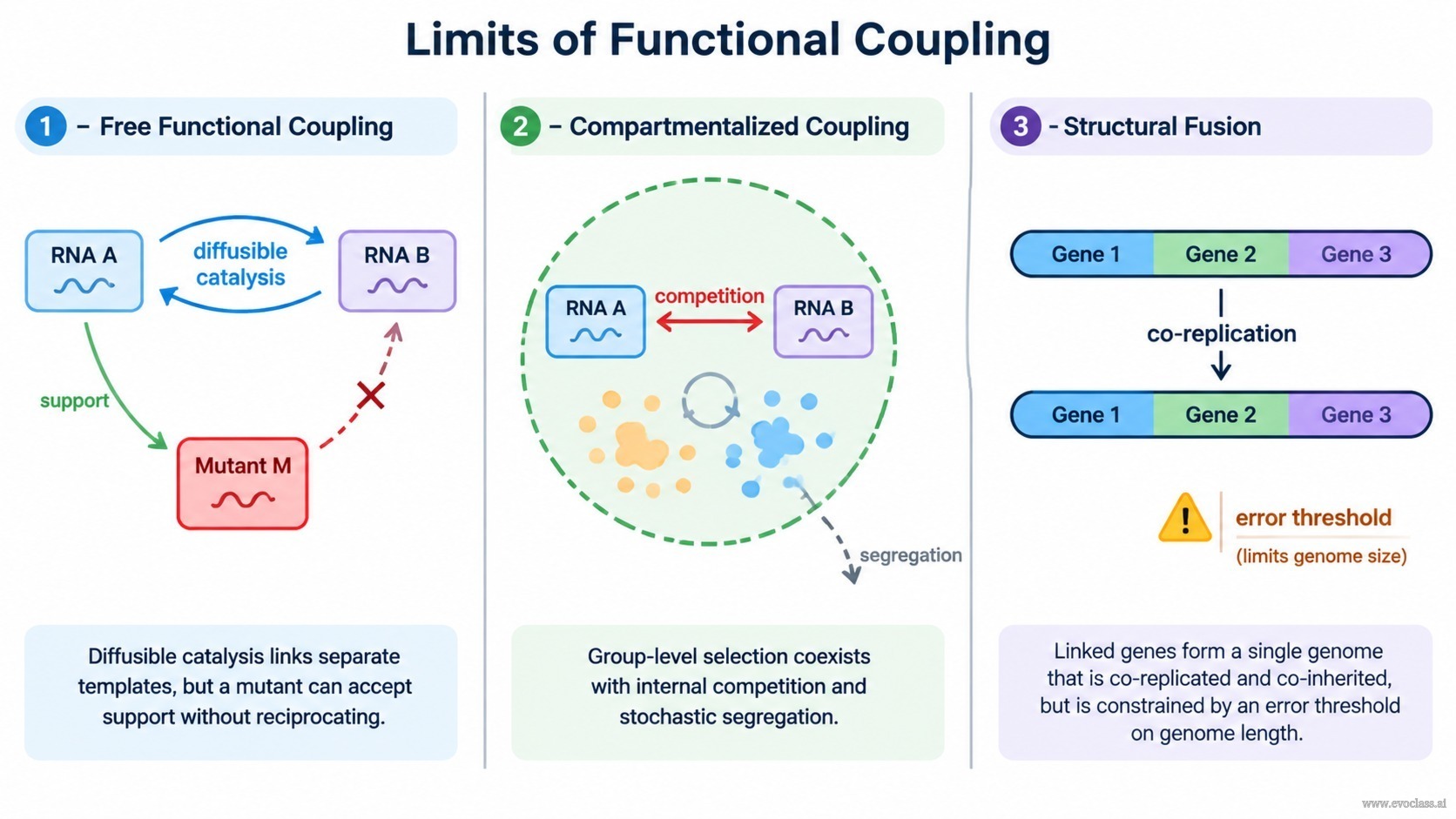
A stable messenger system would require that the cooperating partners be inherited together as a unit. Functional coupling does not deliver that. The coupled molecules remain independent templates, each subject to its own replication, mutation, diffusion and dilution, so the benefits of cooperation are not reliably passed on. Four limitations follow directly.
- Separate competitive units. Each member has its own replication rate and mutation rate. A variant that copies faster, or mutates into a leaner form, spreads on its own merits regardless of the group it belongs to.
- Diffusion and dilution. Catalytic products must diffuse to reach their partners; the same diffusion, and the turnover of the surrounding medium, also removes members from the set. Association is statistical, never guaranteed.
- Exploitable public goods. Catalysis is a shared benefit. A mutant that accepts support but fails to reciprocate gains the group advantage without paying its cost, and can invade the coupled system.
- No co-inheritance. Replicating one template says nothing about whether its partners replicate. Partners can be lost stochastically, so the joint function is not heritable as a set.
Two Routes Toward Stability
Compartmentation. Enclosing the coupled set in a vesicle or protocell keeps the molecules spatially associated. Because the contents travel together, selection can act on the group as a package rather than on isolated molecules, and the local concentration of catalytic products rises. Compartmentation is a genuine advance, but it is not a cure: internal competition for shared resources and stochastic segregation of templates still occur inside the compartment.
Structural integration. Fusing the genes into a single polynucleotide or chromosome physically links their replication and inheritance. Replication now copies the whole set at once, the genome becomes the unit of selection, and the diffusion and cheating problems are largely removed because partners can no longer be inherited separately.
The Trade-Off and the Unresolved Step
Structural integration is not free. Combining many genes into one molecule enlarges the genome, and a longer genome accumulates replication errors more readily, so it runs into the error-threshold limit on how much stable information it can carry. Compartmentation and integration therefore solve the cheating and segregation problems while introducing new constraints of their own.
This leaves the central unresolved step: functional coupling is a plausible requirement for the start of translation, yet it was ultimately replaced by complete structural integration, since even the most primitive known cell genomes are structural units. Explaining exactly how the transition from coupling to integration was achieved — and what intermediate organisations made it possible — remains an open problem.
Limits of Functional Coupling
Three regimes of molecular cooperation compared side by side: free functional coupling, in which diffusible catalysis links separate templates but a mutant can accept support without reciprocating; compartmentalized coupling inside a vesicle, where group-level selection coexists with internal competition and stochastic segregation; and full structural fusion, in which linked genes form a single genome that is co-replicated and co-inherited but constrained by an error threshold on genome length.