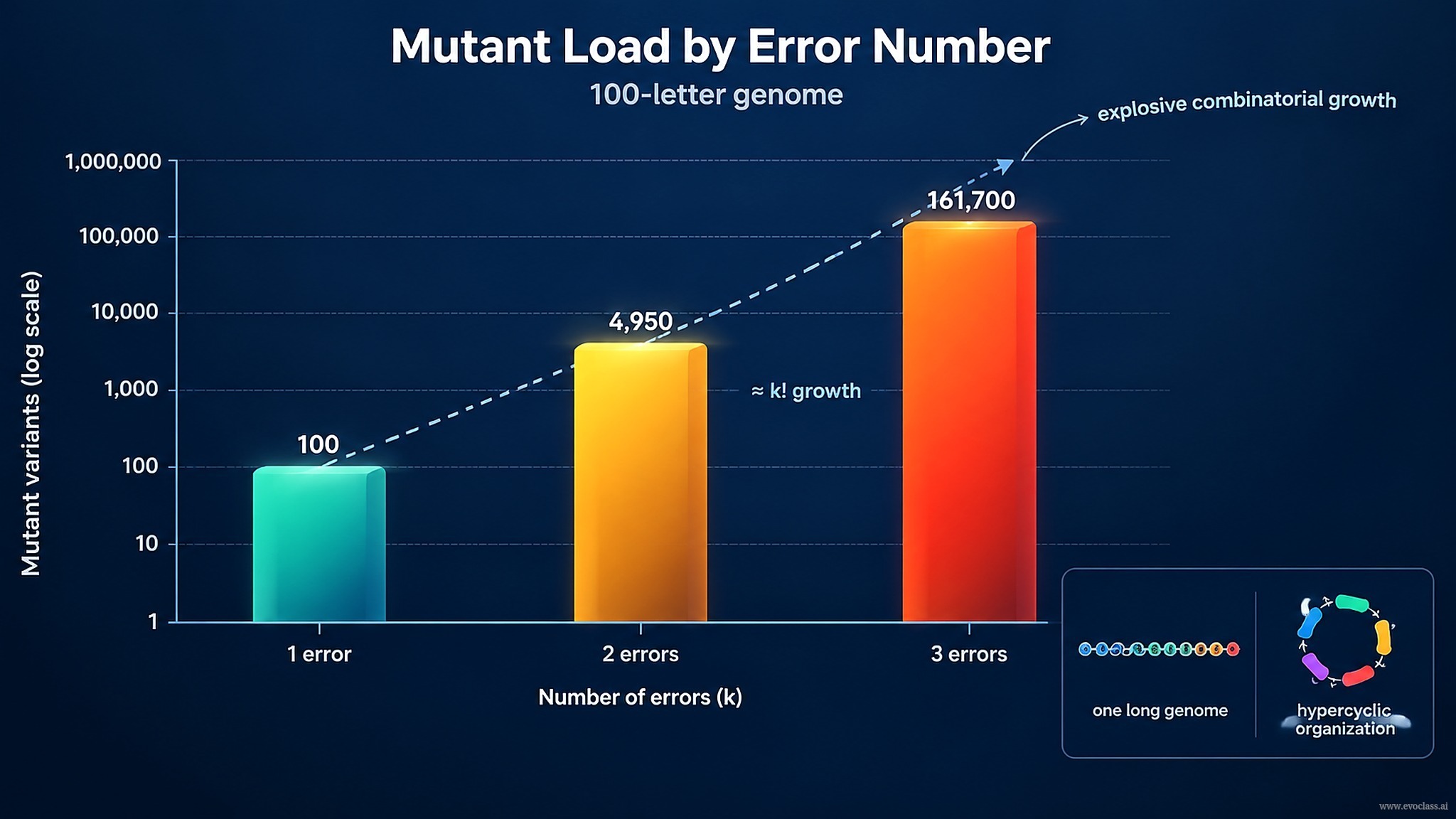
A genome of length n faces more than a single error rate. Under finite replication fidelity, every possible combination of miscopied positions creates a distinct mutant. If exactly k positions are wrong, the number of possible k-error mutants is Nₖ = C(n, k). For a 100-letter genome, the counts are 100 one-error mutants, 4,950 two-error mutants, and 161,700 three-error mutants. The mutant load therefore does not grow linearly; it grows combinatorially with k.
Why a Single Growing Genome Is Vulnerable
A steadily growing genome must maintain its master sequence while suppressing an explosion of nearby alternatives. As n increases, the number of possible k-error mutants for small k rises rapidly. Even if the per-position error rate stays low, the total set of damaged variants becomes a central limitation: selection must keep the whole combinatorial cloud from displacing the functional sequence.
Hypercyclic Organization as an Informational Strategy
Hypercyclic organization offers an alternative: distribute the informational burden among shorter single-mutant genes and integrate them through cyclic catalytic coupling. Shorter units reduce the per-unit mutant load because each gene has fewer positions and thus fewer possible k-error variants. Cyclic coupling then allows selection to act on the hypercycle as a higher-level unit rather than on one long genome. The case for hypercyclic organization is therefore not only catalytic but informational: it organizes mutational diversity at a higher level.
For n genes and Nₖ available k-error mutants, the number of ways to distribute mutants among genes is approximately (Nₖ + n − 1 choose n) ≈ Nₖⁿ / n! for n ≪ Nₖ. This shows how a population of shorter units can manage diversity that would overwhelm a single steadily growing genome.
Mutant Load by Error Number
The chart plots the combinatorial mutant counts for a 100-letter genome on a logarithmic scale: 100 one-error mutants, 4,950 two-error mutants, and 161,700 three-error mutants. The rapid rise shows why one steadily growing genome faces an expanding cloud of damaged variants, while hypercyclic organization distributes shorter genes and integrates them through cyclic catalytic coupling.