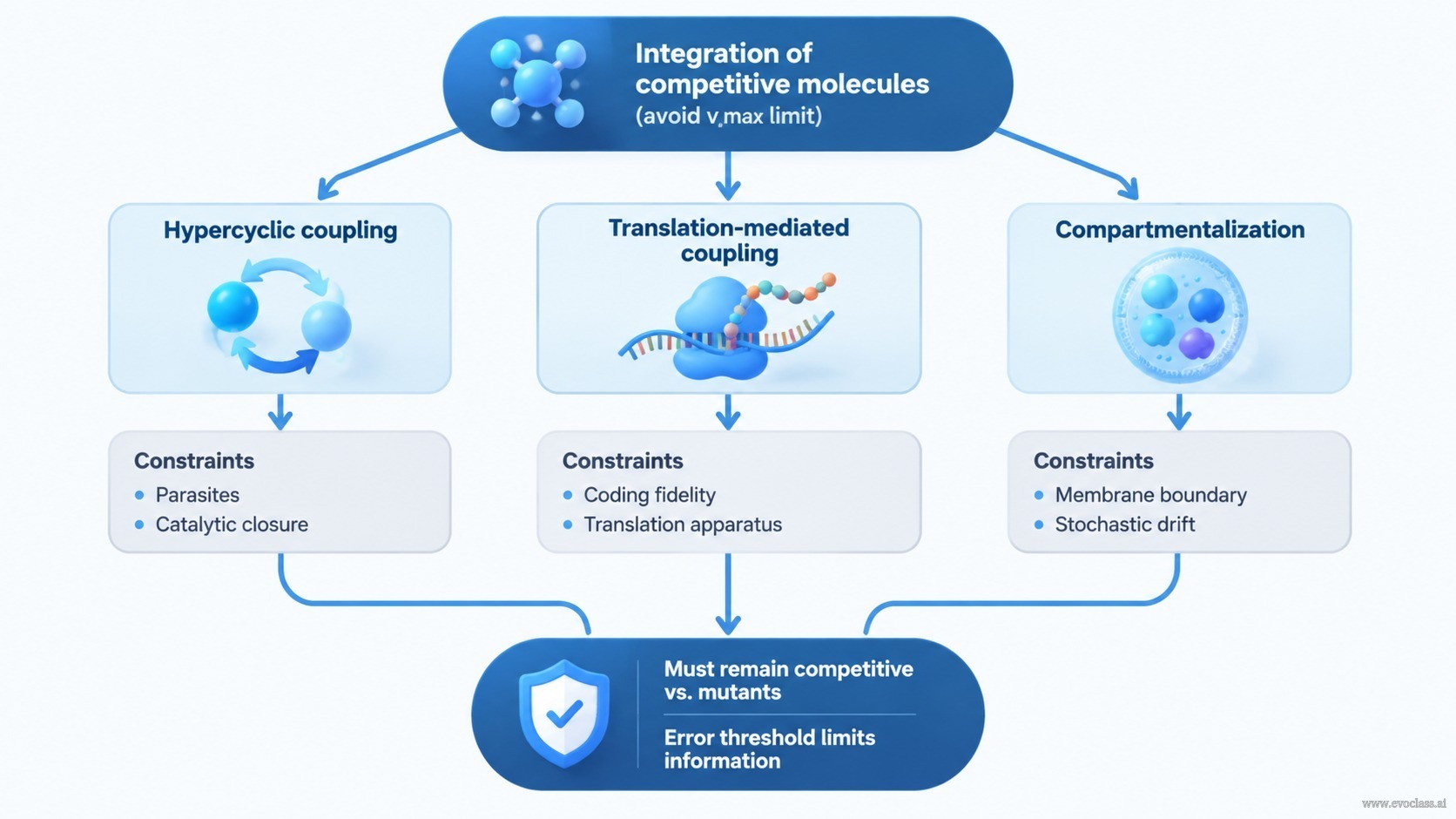
Integration of competitive molecular replicators faces a fundamental constraint: the error threshold. A single long replicative unit—produced, for example, by ligating several genes into one genome—accumulates too many mutations per replication cycle. Once the mutation rate exceeds the threshold, the master sequence is lost and the specific information encoded in that unit degrades. Therefore, integration cannot be achieved merely by making one longer molecule; the integrated unit must remain selectable against its own mutant distribution.
Three alternative routes have been proposed for integrating competitive molecules without violating the threshold relation for
- Hypercyclic coupling: genes are linked through a closed catalytic cycle, so each gene's replication depends on the products of the others. This creates a unit of selection at the hypercycle level, but it remains vulnerable to parasitic mutants and requires catalytic closure.
- Translation-mediated coupling: genes encode functionally active proteins (for example, replicases or synthetases) that catalyze replication or translation. This permits division of labor and can integrate more information than a single RNA genome, but it requires a coding apparatus and faces fidelity constraints.
- Compartmentalization: cooperative genes are enclosed in a common compartment (a protocell), so selection acts on the compartment as a whole. This can stabilize integration and limit parasite exploitation, but it introduces boundary maintenance, stochastic effects, and coordinated replication constraints.
These routes are not mutually exclusive. Early evolution may have combined hypercyclic organization, translation, and compartmentalization to achieve integrated genomes. The common constraint is that each route must remain within the error threshold and manage mutant load: integration is a selective problem, not merely a physical association.
Three Routes to Integration
The diagram shows a central integration problem splitting into hypercyclic coupling, translation-mediated coupling, and compartmentalization. Arrows from each route lead to shared constraints: remain competitive against mutants and stay within the error threshold.