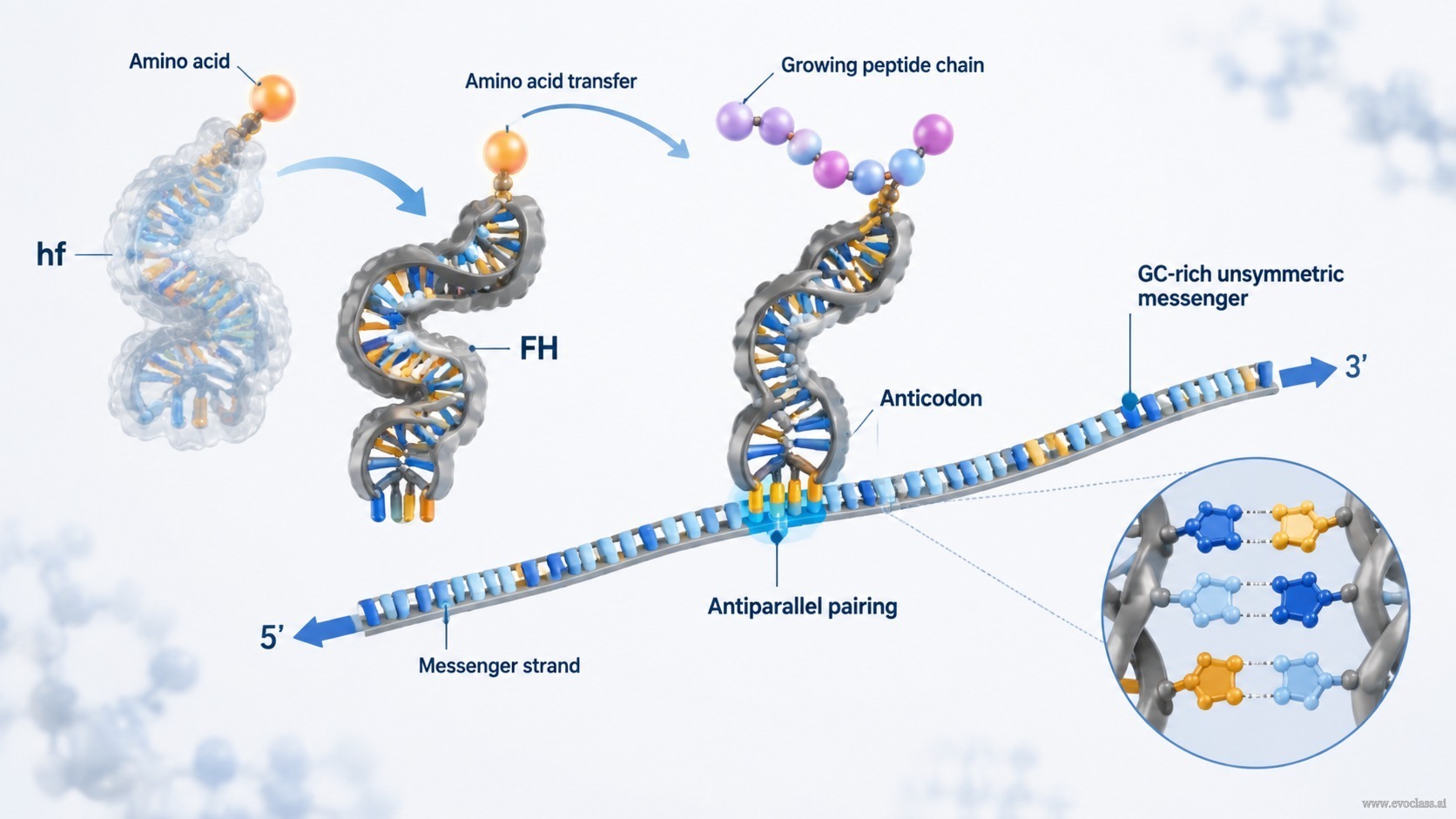
Translation in early life need not have begun with a fully formed ribosome. The model proposes that simple tRNA-like adapters could read a messenger by complementary, antiparallel pairing, provided that catalytic support for peptide bond formation is available. The adapter's configuration depends on its cargo: it adopts the hf configuration when it carries an amino acid and the FH configuration when it carries a peptide chain. Transfer of the amino acid to the growing peptide chain flips the adapter from hf to FH (cf. Fig. 49).
Because adapter–messenger alignment is antiparallel, a message can be read off without a sophisticated translation apparatus. The choice of GC-rich starting patterns is dictated by four arguments, including stability of adapter–messenger interaction and fidelity of replication, both favoring GC combinations to start with, and comma-free read-off in translation requiring an unsymmetric GC pattern. Thus comma-free messenger patterns arise from unsymmetric GC patterning that permits reading without separators or a complex translational machinery.
Key mechanistic points
- Catalytic support is still needed for translation functions, but early translation may use simple adapters rather than a full ribosome.
- Cargo-dependent conformation: the tRNA configuration depends on whether it carries an amino acid or a peptide chain. Transfer flips hf to FH.
- Antiparallel pairing: adapter–messenger complementary alignment is antiparallel, enabling read-off without sophisticated apparatus.
- GC-rich, unsymmetric patterns: stability and replication fidelity favor GC; comma-free read-off requires unsymmetric GC to avoid overlapping-frame ambiguity.
Adapter–Messenger Read-Off
This diagram shows tRNA-like adapters in hf and FH configurations, antiparallel complementary pairing to a GC-rich unsymmetric messenger, and the amino-acid transfer that flips hf to FH, enabling comma-free read-off without a sophisticated ribosome.