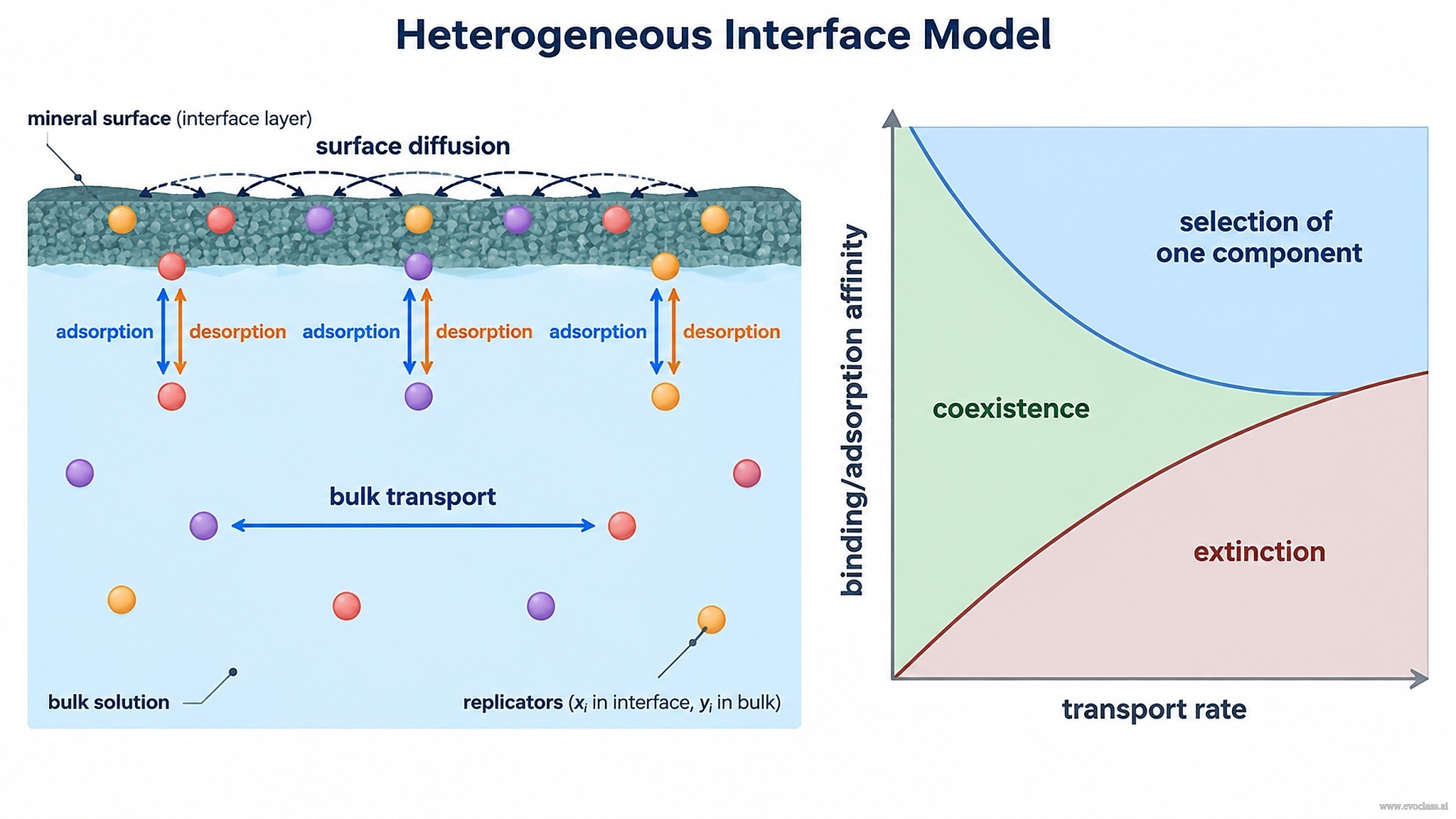
The heterogeneous interface model extends coupled replication–selection dynamics beyond the well-mixed, constant-organization picture. Instead of treating the system as one homogeneous reactor, it treats it as two coupled phases: an interface and a bulk solution. Replicators undergo lateral surface diffusion on the interface, adsorb and desorb between interface and bulk, and are transported within the bulk. Interface populations are written
Three coupled processes
- Surface diffusion: replicators move laterally along the interface, so mixing is limited to the interface length scale rather than the whole volume.
- Adsorption and desorption: molecules bind to and leave the interface at rates that determine how long a replicator is retained in the surface layer.
- Bulk transport: flow and diffusion in the solution carry replicators through the pore or vessel, diluting some regions and delivering others.
Long-time steady behaviour and the three outcomes
At long times the interface and bulk populations approach steady behaviour: ∂
- Coexistence — the components persist together in a stable interface–bulk distribution.
- Selection of one component — a single component displaces the others.
- Extinction — replication and retention cannot compensate transport and loss, so no component is sustained.
Which outcome occurs depends on transport rates together with binding and adsorption parameters. In a two-component reduction, balanced adsorption/desorption with comparable surface and bulk transport can support coexistence; asymmetric binding or transport can let one component displace the other; and when transport and loss exceed replication and retention, extinction results.
Heterogeneous Interface Model
Replicators on the interface (xᵢ) diffuse laterally, exchange with the bulk solution (yᵢ) by adsorption and desorption, and are carried by transport in the bulk. Because these processes couple the two phases, the long-time outcome is not the well-mixed hypercycle result: it settles into coexistence, selection of one component, or extinction, depending on transport rates and binding/adsorption parameters.