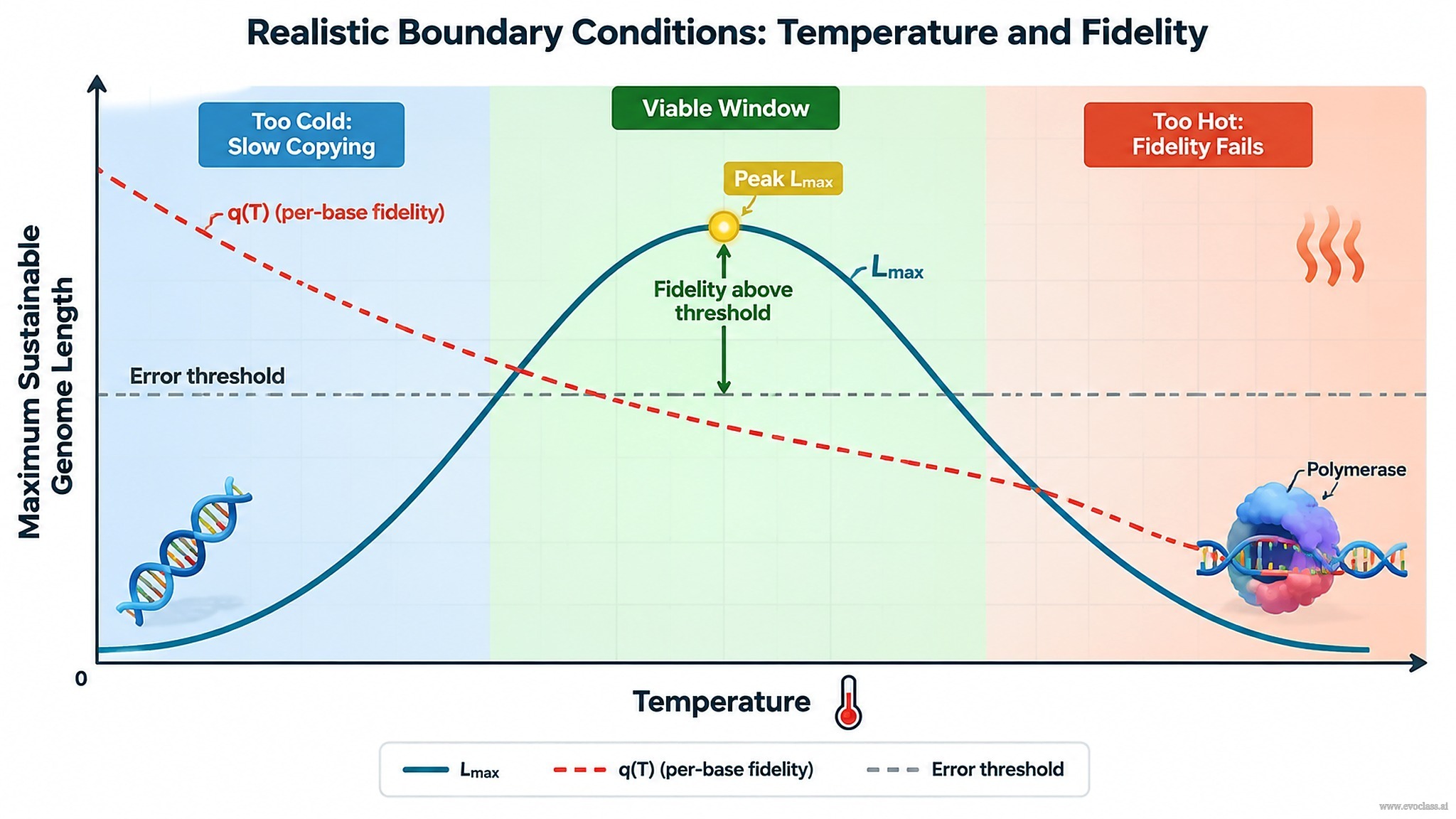
Temperature is a realistic boundary condition for hypercycle and quasi-species selection because it changes replication fidelity, and fidelity in turn sets the maximum length of polynucleotides that can be maintained against mutation. In the error-threshold picture, a population can sustain a genome length L only if its per-base fidelity q is high enough; otherwise the error threshold is crossed and information is lost.
Fidelity, Error Threshold, and Length
Let q be the probability of correct copying per base and 1 − q the per-base error rate. A simplified error-threshold relation is
How Temperature Enters
- Higher temperature generally lowers fidelity. Increased thermal energy promotes strand separation and raises the chance of copying errors, so q tends to fall as T rises.
- Lower fidelity shortens
. Because ∝ 1/(1 − q), a tenfold increase in error rate reduces the sustainable length by roughly an order of magnitude for a fixed σ. - Higher fidelity permits longer polynucleotides. If temperature is moderate enough to keep copying accurate, longer genes and more integrated hypercycle functions can be selected.
- Temperature also changes kinetics and duplex stability. Very low temperature can slow replication and over-stabilize duplexes, limiting turnover; very high temperature can melt duplexes and collapse fidelity.
Joint Constraints on Hypercycle Information Capacity
Temperature therefore does not act through a single channel. A viable hypercycle must simultaneously satisfy three constraints: replication must be fast enough to compete, duplexes must be stable enough to retain information, and per-base fidelity must be high enough to keep
Temperature–Fidelity Window
Maximum sustainable polynucleotide length is set jointly by replication fidelity and reaction kinetics. Higher temperature lowers per-base fidelity and shortens the error-threshold-limited length, while very low temperature slows copying and over-stabilizes duplexes; the viable regime is an intermediate thermal window.