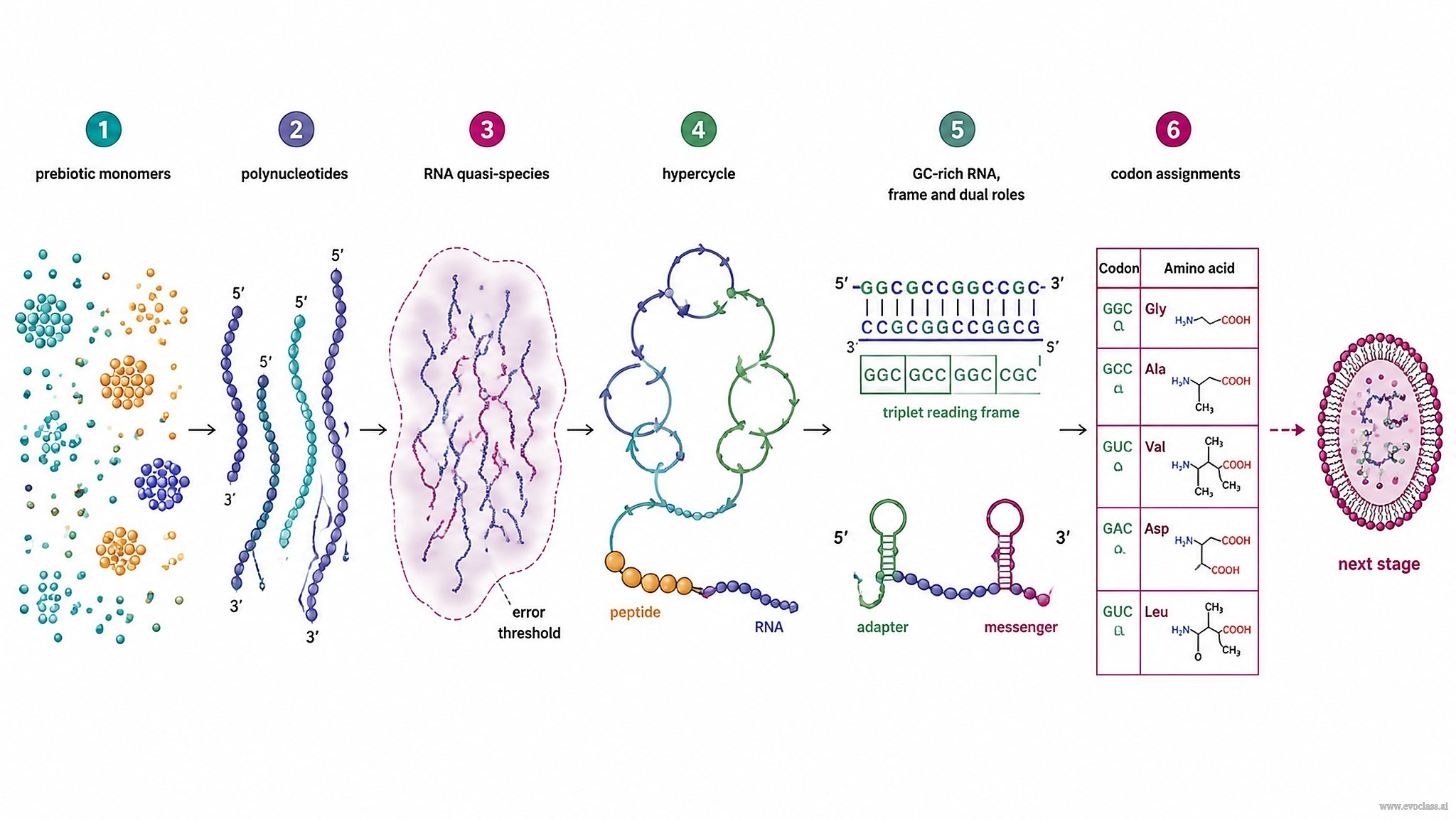
This page assembles the proposed continuity from prebiotic macromolecules to the first codon assignments. The claim is not that one event produced a genetic code, but that a series of physical and informational steps progressively narrowed the space of possible assignments until only a small, workable mapping of triplets to amino acids remained.
1. A nonrandom starting pool
Prebiotic synthesis does not deliver a uniform mixture. Amino acids and nucleotides accumulate with strongly nonrandom abundances, and those biases propagate upward: whichever monomers are plentiful and persistent are the ones actually available to be captured by the earliest coding interactions. Availability, not optimisation, sets the initial menu from which any assignment must be drawn.
2. Polynucleotides as quasi-species, not single molecules
Early polynucleotides do not evolve as one optimised sequence but as a quasi-species: a cloud of related variants held in mutation–selection balance. Its information content is capped by the error threshold — if the per-site mutation rate is too high, the master sequence dissolves into a flat, uninformative mutant distribution. Low replication fidelity also imposes a mutant load that suppresses longer molecules. Early coding therefore starts from short, error-threshold-limited sequences, not from a long protogenome.
3. Functional coupling and hypercyclic organisation
Coupling RNA catalysis to peptide function allows replicators that would otherwise compete to support one another. Hypercyclic organisation is the proposed way to integrate these functions and to address the standard objections: nucleation (how the cycle begins at all), parasites (shorter species that exploit the cycle without contributing), and information loss. Coupling stabilises coding-like interactions before any genome exists.
4. The constraints that shape early coding
- GC-rich replication biases the accessible sequence space toward G/C-rich templates.
- Comma-free frames avoid frameshift ambiguity, so only certain triplet codes can be read without delimiters.
- Dual-purpose RNA: the same molecule may serve as an adapter carrying an amino acid and as a messenger being read, so any assignment must satisfy both roles simultaneously.
5. First assignments and the route onward
Within these constraints, the earliest codon assignments plausibly involve GGC/GCC-like triplets matched to relatively abundant aliphatic amino acids. The transition is a gradient, not a jump: it presupposes error-threshold-limited information, catalytic closure, and only later compartmentalisation, which unifies the genome inside a single boundary and yields the integrated protocell.
Summary objective: be able to recount the proposed order of events — macromolecules and quasi-species, then codon assignments, then compartmentalised hypercycles, and finally the integrated protocell.
From Macromolecules to Codon Assignments
A linear continuity pathway in which nonrandom prebiotic monomer pools feed polynucleotide pools, which persist as RNA quasi-species under mutation–selection balance bounded by the error threshold. Functional RNA–peptide coupling and hypercyclic organisation then support GC-rich, comma-free frames with dual-purpose adapters and messengers, from which the first codon assignments emerge — with compartmentalised hypercycles, an integrated protocell, and a unified genome marked as the next stage rather than part of this step.