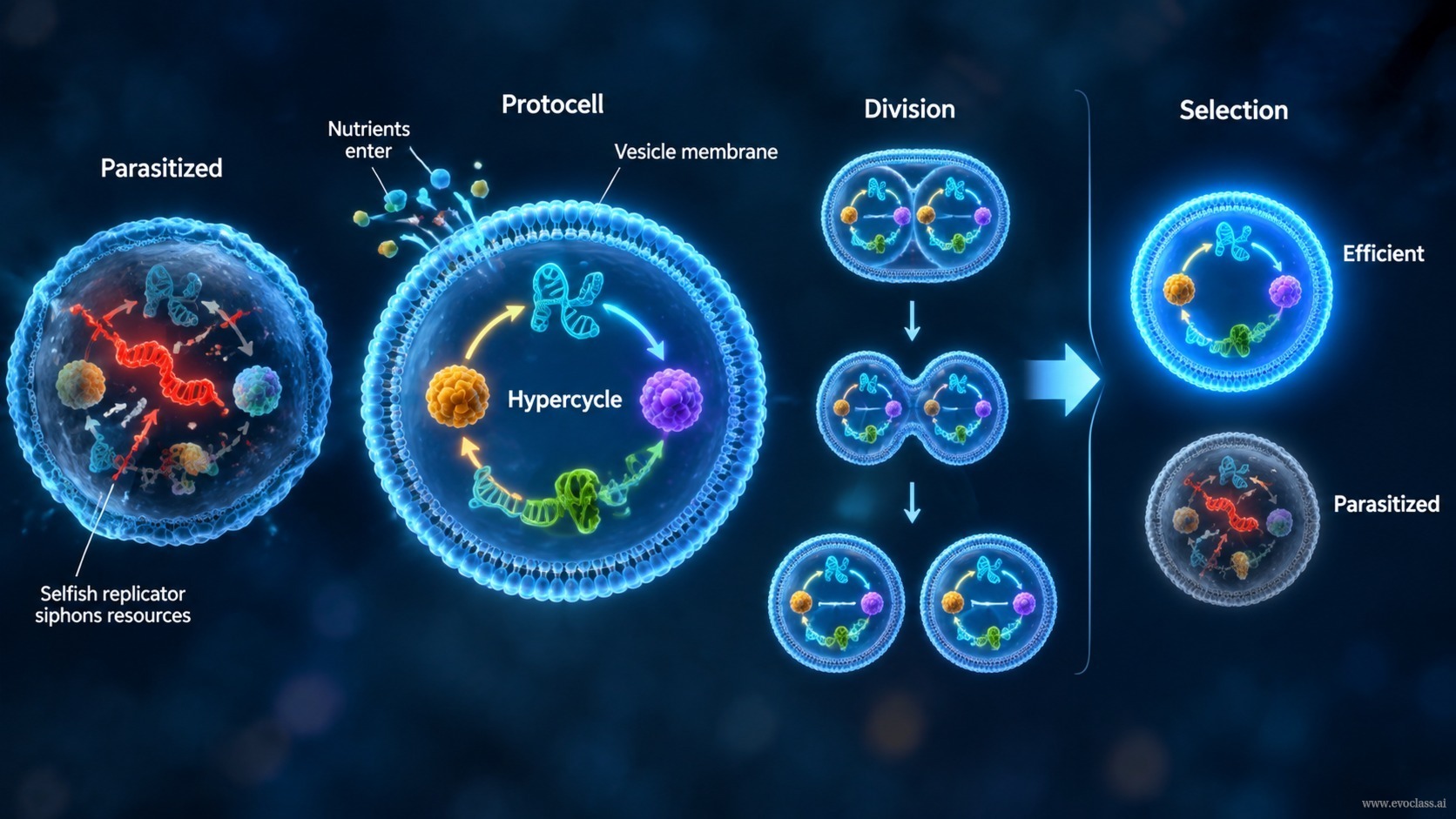
Compartmentation is a pivotal transition in the evolution of early life: it converts a functionally coupled hypercycle—a set of self-replicating molecules whose replication is mutually catalytic—into a protocell, a membrane-bound unit that can be selected as a whole. Inside the vesicle, the hypercyclic dynamics persist: each replicator catalyzes the replication of the next, forming a closed cycle of mutual dependence. However, the boundary introduces a new level of organization. It retains the catalysts and their products in close proximity, ensuring that the catalytic benefits remain associated with the replicators that produce them. This spatial confinement prevents the diffusion of beneficial molecules away from their source and reduces the opportunity for parasitic subcycles to exploit the system without contributing to the collective.
Selection now acts on the compartment level. Vesicles that exhibit a higher collective replication rate, greater internal stability, and more efficient division outcompete those that are less efficient or that harbor parasitic elements. The fitness of a protocell depends on emergent traits: the strength of catalytic coupling among its components, its resistance to parasitic subcycles, the fidelity with which components are segregated during division, and the rate at which it grows and divides. Importantly, the growth and division of the compartment must be coupled to the internal replication of its molecular constituents; if division occurs randomly or is uncoupled from replication, advantageous hypercycles may be diluted or lost.
Compartmentation thus resolves a fundamental limitation of hypercyclic organization: by allowing cooperative networks to compete as integrated wholes, it provides a mechanism for the evolution of complexity. Yet, viability is constrained by physical realities: nutrient uptake across the membrane, membrane permeability, temperature, and replication fidelity all impose boundary conditions. The interplay between these constraints and the internal dynamics determines which protocells survive and proliferate.
Example: Selection Between Vesicles
Consider two vesicles, each containing a different hypercyclic network. Vesicle A has efficient catalytic coupling and divides rapidly, while Vesicle B contains a parasitic subcycle that saps resources or segregates essential components poorly. Over successive rounds of growth and division, the population of Vesicle A increases relative to Vesicle B. The selected trait is the protocell's collective internal network—not any single molecule—demonstrating that selection operates on the integrated compartment.
Vesicle-Encapsulated Hypercycle
A protocell with a membrane boundary encapsulates a hypercyclic network of replicators and catalysts. Nutrients enter through the membrane, and the compartment grows and divides. A population panel shows selection favoring vesicles with efficient catalytic coupling over those with parasitic subcycles.