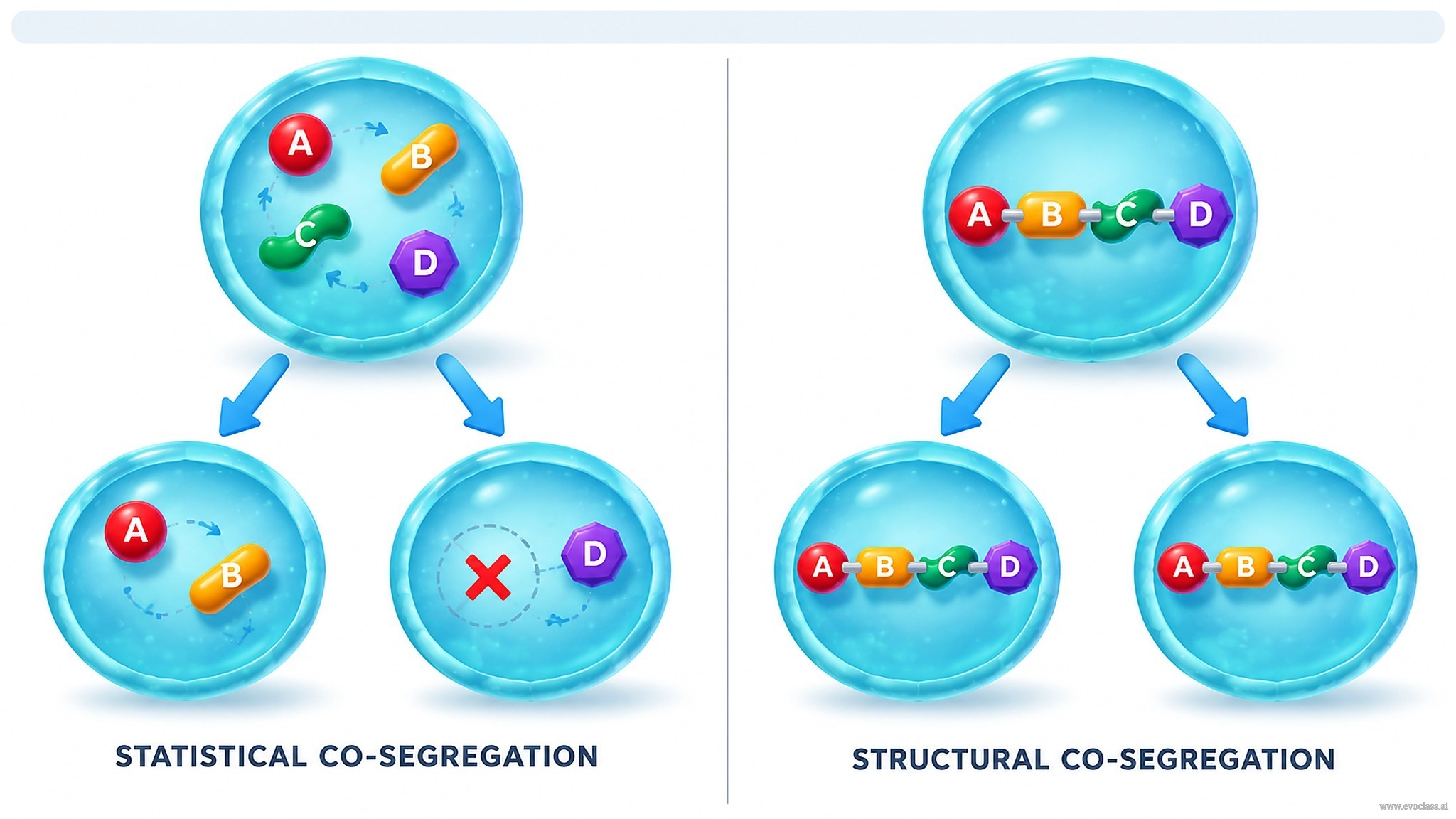
An unified genome marks the transition from compartmentalized hypercycles to integrated cellular inheritance. In a hypercycle, replicators are functionally coupled but physically separate; each must be replicated and segregated independently. A unified genome links formerly separate genes into one structural unit, so genes that must function together are inherited together, reducing dependence on statistical co-segregation and permitting coordinated replication.
From Statistical to Structural Co-Segregation
- Co-inheritance: A unified genome ensures all genes are inherited together as one structural unit.
- Reduced loss: Structural integration reduces the chance of losing essential partners during compartment or cell division.
- Shared machinery: A single replication and regulatory apparatus can improve efficiency and fidelity relative to independently replicated components.
- Stabilized coordination: Unified inheritance stabilizes functions that hypercyclic coupling had only partially integrated.
Why It Matters
In a multi-replicator protocell, each daughter compartment must receive every essential replicator; stochastic segregation can omit one component and break the integrated function. In a unified-genome cell, one linked genome carries the full set, so a single replication and segregation event preserves the integrated system. This transition connects compartmentalized hypercycles and protocells to the integrated cell, providing continuity from polynucleotides to cellular genomes.
Unified Genomes
Side-by-side comparison: a multi-replicator protocell (left) loses an essential component during division because independent replicators segregate by chance, while a unified-genome cell (right) carries all linked genes as one structural unit, so a single division event preserves the integrated system.