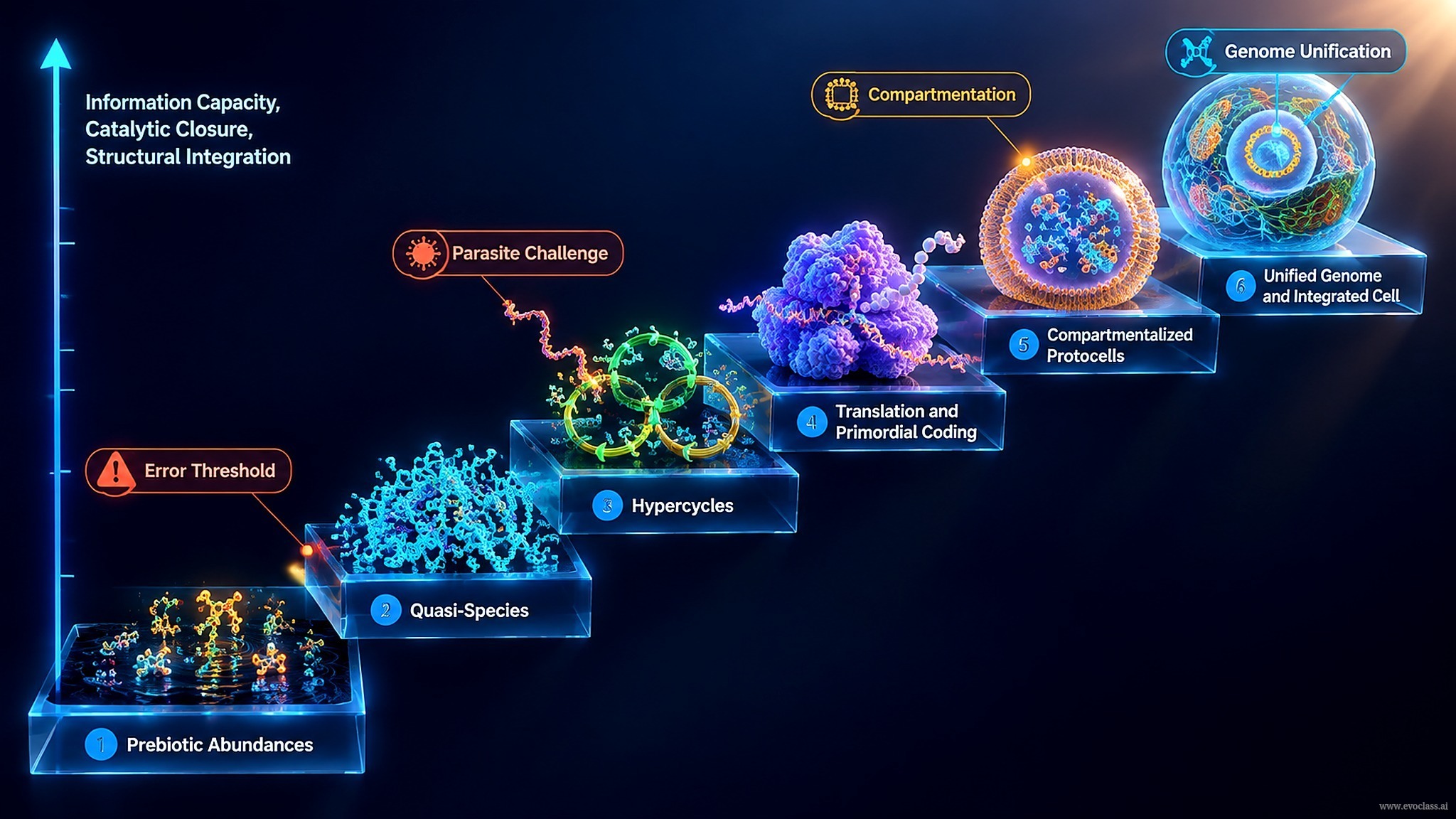
The integrated cell is not a separate origin of life but the end point of a continuous, staged extension of molecular self-organization. Each stage solves a specific information, catalytic or parasitic problem while Darwinian selection continues to operate at the molecular level.
- Stage 1 — Prebiotic raw material: prebiotic synthesis yields amino acids and polynucleotides with nonrandom abundances; compositional biases such as GC-rich replication constrain the earliest replicators.
- Stage 2 — Quasi-species: mutation and selection generate quasi-species populations whose stable information content is limited by replication fidelity and the error threshold; q̄m, σm and vm predict information loss or maintenance.
- Stage 3 — Hypercyclic integration: catalytic, autocatalytic and hypercyclic couplings link replicators into cooperative cycles with coherent growth; parasites, mutant load and nucleation failure define the limits of hypercyclic organization.
- Stage 4 — Translation and primordial coding: RNA adapters/messengers, comma-free frames, early GGC/GCC codons and ribosome-free peptide transfer extend hypercycles to encoded functional polypeptides.
- Stage 5 — Compartmentalization: compartmentalized hypercycles and protocells localize coupled replication and translation, suppress parasitic exploitation, and create higher-level units of selection under realistic boundary conditions.
- Stage 6 — Genome unification: multiple hypercyclic replicators are consolidated into an integrated genome; DNA proofreading, recombination and improved fidelity shift the error threshold and permit larger integrated cells.
Continuity principle: the transitions are not separate origins but successive increases in catalytic closure, information capacity and structural integration; failure modes such as error catastrophe, parasitic exploitation and joint-function failure mark boundaries that later stages must overcome.
Formal synthesis with selection theory: fixed-point and Jacobian analysis, limit cycles, Hopf bifurcation and coupling regimes describe when integration is stable and when it collapses. Qβ phage mutagenesis illustrates mutant distributions and the error threshold, and the sentence-evolution game shows how fidelity limits information; DNA proofreading and recombination later relax this limit, helping explain how unified genomes could emerge from earlier RNA/protein hypercycles.
Continuity from Polynucleotides to the Integrated Cell
A six-stage staircase from prebiotic abundances to the unified genome, with the upward axis marking growth in information capacity, catalytic closure and structural integration; callouts flag the error threshold, the parasite challenge, compartmentation and genome unification.